


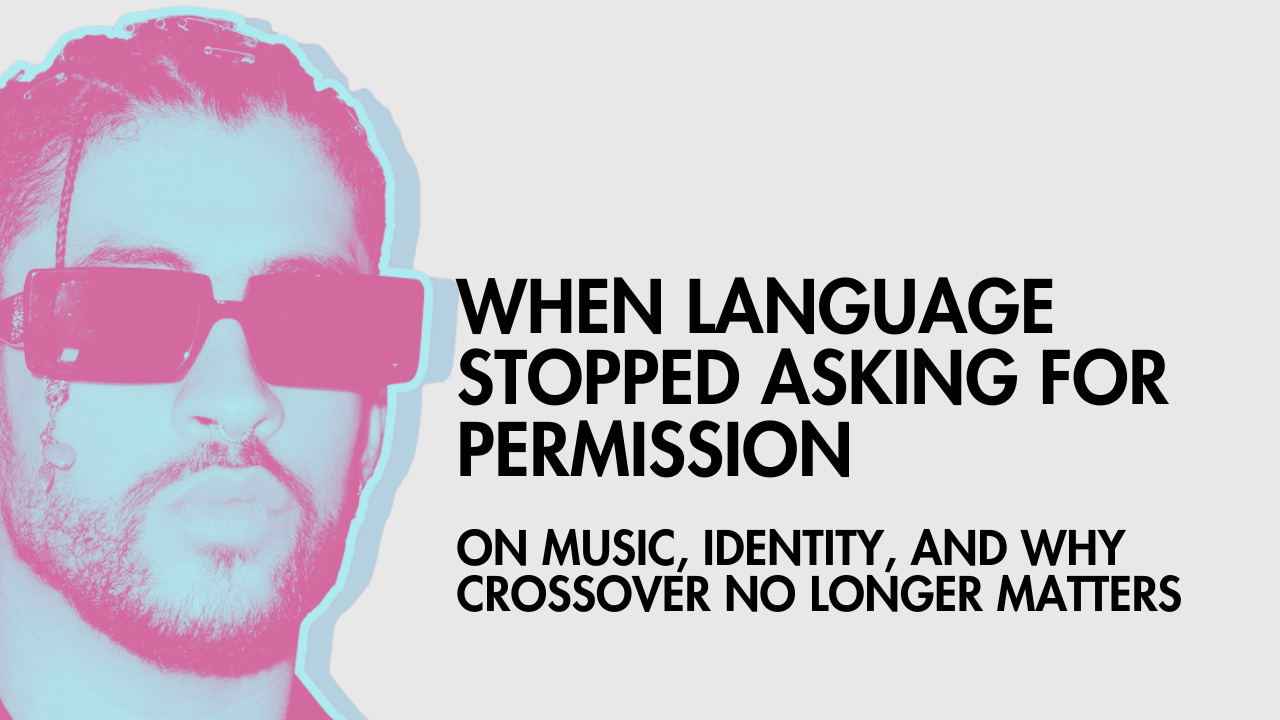
I’ll admit it. Like everyone else, I’m about to jump on the Bad Bunny bandwagon.
The Super Bowl. The Grammys. Spanish on one of the biggest stages in global pop culture, delivered without translation, apology or explanation. By now, the headlines, opinion pieces, Instagram posts and TikToks have done their rounds. We’ve all read some version of the story.
But what interests me isn’t Bad Bunny himself, nor the spectacle of the moment. It’s what that moment quietly confirms, that language itself has stopped functioning as a cultural checkpoint.
For a long time, it did.
What interests me is not the moment itself, but the quiet assumption that preceded it, and why it took so long to disappear.
Growing up in the 1980s, while living in South Africa, I remember a small pattern among my group of friends on my street. Our mothers all listened to the same artist, but never in the same language. In my house, it was Italian. Next door, Portuguese. And if you went to Pilar, my mother’s hairdresser, Spanish. Same melodies, same voice, different linguistic skins.
The artist? Julio Iglesias. (At this point, I should probably acknowledge that I’m showing my age.)
Looking back, that memory says more about the cultural logic of the time than any chart statistic. Julio Iglesias was an international star, but his internationalism depended on adaptation. He didn’t expect audiences to meet him halfway; he met each of them exactly where they were, linguistically and culturally. Spanish alone wasn’t expected to travel. So it travelled in translation.
The same could be said of Charles Aznavour, whose international reach was built on singing in multiple languages rather than asking audiences to adapt to one.
That logic wasn’t unique to pop music or to Europe.
Consider Miriam Makeba. Pata Pata became a global hit, but the versions that travelled most easily were the ones adapted for Western audiences. Even her so-called “Click Song” was renamed because its original Xhosa title, Qongqothwane, was considered unpronounceable.
The music moved. The language had to bend. It was never about talent. It was about legibility. Culture was welcome, as long as it arrived already translated.
Throughout the 1980s and into the 1990s, this was the prevailing model. Artists who wanted to cross borders learned to soften their edges. They recorded multiple versions of the same album. They adjusted accents. They translated not just lyrics, but identity.
You could be enormous within a language and still remain outside the idea of the “global”. Luis Miguel was a pan-Latin icon long before the global industry took notice. His success didn’t lack scale; it lacked recognition within an Anglophone framework that decided what counted as universal. Long before Bad Bunny, Luis Miguel filled arenas across Latin America and Spanish-speaking communities worldwide, remaining largely faithful to Spanish, with a small foray into Italian (coming second at the 1985 San Remo music festival by the way!) He didn’t chase crossover; he deepened his own territory.
His career is a reminder that Spanish never lacked reach. It lacked institutional confidence.
By the late 1990s and early 2000s, the rules hardened. English became the passport to global pop legitimacy. The crossover era wasn’t subtle about it.
Artists like Shakira navigated this with intelligence and precision, building parallel careers in different languages. Ricky Martin became the emblem of a moment when Latin energy was embraced by the mainstream, the kind of era where María, Whenever, Wherever or Bailamos were impossible to escape, whether you asked for them or not.
Enrique Iglesias, in many ways, refined that model, sustaining a bilingual career designed to move seamlessly between markets.
The burden was always on the artist. The audience stayed still.
What’s often forgotten is that Spanish was never marginal. It was simply unevenly recognised.
Italian artists understood this early. Rather than turning to English, many released entire albums in Spanish, recognising its reach across Europe and Latin America. Domenico Modugno, Raffaella Carrà, Eros Ramazzotti and Laura Pausini didn’t treat Spanish as an accessory, but as a second creative home. The language carried emotion, intimacy, familiarity. It didn’t need validation.
Audiences, meanwhile, were already fluent in culture if not in grammar. We didn’t need to understand every word to feel something. That was always true. What changed was whether institutions acknowledged it.
Then something shifted. Not abruptly, but unmistakably.
I lived in Miami from 2017 to 2022, exactly the period when Bad Bunny was rising. What struck me wasn’t just his popularity, but how no one spoke of crossover. There was no sense of translation or accommodation.
Spanish wasn’t a statement. It was simply the language of life. Miami revealed something global commentary often misses: for millions of people, the audience had already moved. The industry was catching up to reality, not leading it.
In 2020, I was invited by TelevisaUnivision to be one of the analistas de estilo on the red carpet of Premio Lo Nuestro, live from what was then the American Airlines Arena. Surrounded by artists, media and audiences who had long moved past the idea of linguistic adaptation, it became clear that the shift had already happened. Later that evening, the lineup told its own story. Ricky Martin, Alejandro Sanz, J Balvin, and Bad Bunny on the same stage. Different generations, different strategies, different relationships to language, sharing one cultural space without hierarchy.
Culture was welcome, as long as it arrived already translated.
Today, audiences don’t approach music expecting translation. They expect authenticity. Language has become texture rather than threshold. Streaming didn’t invent multilingual listening. It removed the gatekeepers who pretended it was risky. That’s why Bad Bunny matters, but not because he sings in Spanish on big stages. He matters because he doesn’t adjust his language to inherited hierarchies, and no one seriously expects him to anymore.
The idea of “crossover” itself begins to feel outdated when the audience is the one doing the crossing.
What we’re witnessing isn’t the replacement of English, nor the rise of a new monoculture. It’s something more interesting and more fragile: a recalibration of cultural confidence. It’s about the collapse of an assumption that language must be neutralised to be understood.
Language is no longer an apology. It doesn’t need to be justified, diluted or explained. It can arrive whole, carrying history, politics, humour and contradiction without asking permission.
From Miriam Makeba to Julio Iglesias, from Luis Miguel to Miami’s everyday soundscape, artists have long navigated systems that demanded adaptation. What’s changed is not our ability to feel across languages, but our willingness to let artists stay where they are.
Looking back, that childhood street in South Africa already contained the future. We shared culture across languages without ever questioning whether we were “allowed” to. What’s changed is that artists are no longer required to translate themselves to make that sharing legitimate.
The burden has moved. Quietly, decisively.
And perhaps that is the real cultural shift of our time. Not that we all understand each other’s languages, but that we’ve finally stopped demanding it as the price of belonging.