


There was a time when fashion houses had unmistakable signatures. Not just logos, monograms or marketing campaigns, but something deeper. A system of codes.
You could recognise them from a line of a jacket, the architecture of a silhouette, the rhythm of a collection.
Fashion houses behaved like languages. Each had its grammar, its vocabulary, its syntax.
Chanel spoke in tweed, pearls and bourgeois rebellion. Dior spoke in structure and controlled femininity. Balenciaga spoke in sculptural experimentation.
In The Fashion System, Roland Barthes famously described fashion as a system of signs, arguing that garments function like language, communicating meaning through repetition and structure. A brand’s identity was built through the consistent re-articulation of its codes.
For decades, creative directors were not expected to erase this language. They were expected to translate it. Karl Lagerfeld reinvented the house continuously, yet the Chanel grammar remained recognisable:
Tweed. Camellias. Chains. Black and white. Bourgeois restraint mixed with irreverence.
The codes evolved, but they remained legible.
Today, that relationship feels increasingly different. Each appointment triggers the same question. Are these designers preserving the DNA of their houses? Or being invited to rewrite it entirely?
And perhaps this is the real shift happening in fashion today. Designers are no longer interpreters of house codes. They are protagonists whose personal identities often become stronger than the brands they inherit.
When the designer becomes the brand, the house becomes scenery.
The designer’s vision often overrides the house’s original vocabulary, raising a larger question: do house codes still exist, or are they simply dissolving into the personalities of the designers who run them?
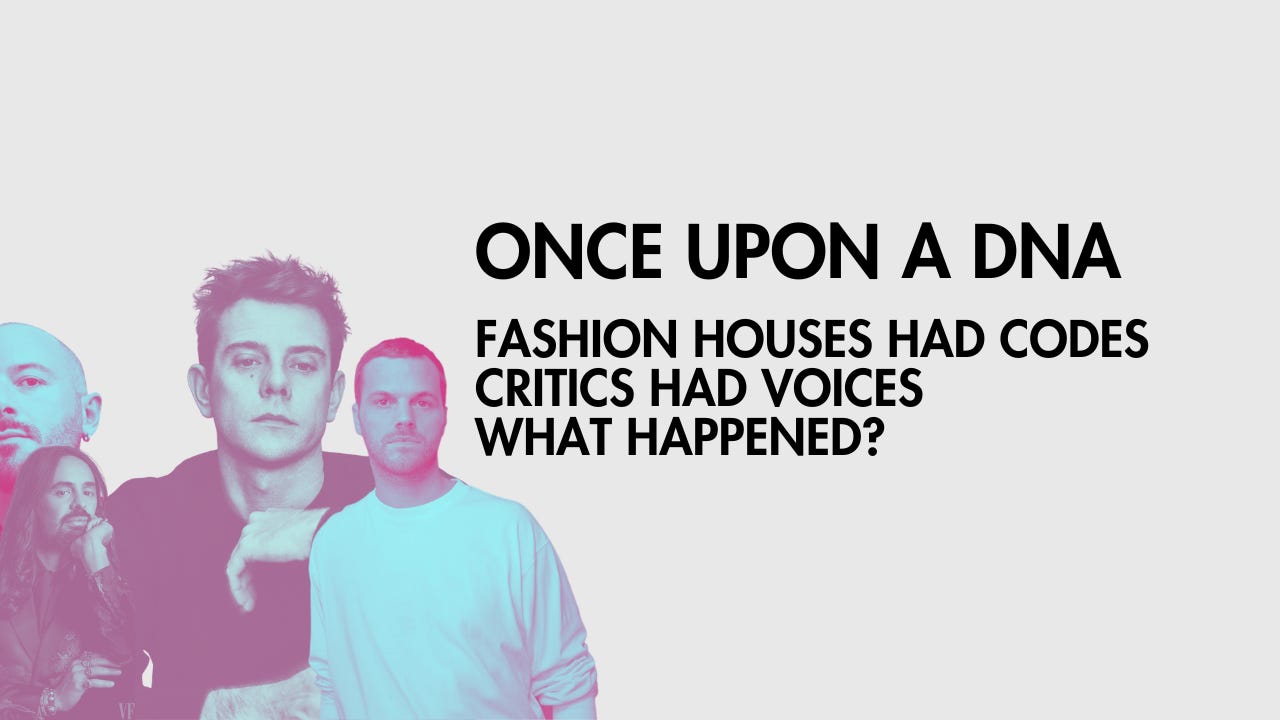
The last two Paris fashion weeks have made this especially visible. The industry is watching closely as Matthieu Blazy continues to redefine Chanel, playing with the house’s classic tweeds and silhouettes while introducing new materials and unexpected proportions. Meanwhile, Jonathan Anderson’s arrival at Dior has been framed as one of the most significant creative shifts of the season, another moment in fashion’s constant cycle of reinvention.
Alessandro Michele’s latest vision for Valentino feels unmistakably like Alessandro Michele. The layered romanticism, the archival references, the theatrical collage of eras. It is beautifully executed. But it also raises an uncomfortable question: When the designer’s identity becomes so dominant, what happens to the identity of the house?
Demna’s Balenciaga operated in a similar way. For nearly a decade, the house ceased to be primarily about Cristóbal Balenciaga’s architectural couture legacy, becoming instead a platform for Demna’s cultural commentary on luxury, irony, and spectacle.
His recent work at Gucci only reinforces this shift. Watching the latest collection, one cannot help but recognise familiar gestures from his Balenciaga universe. The designer’s language travels with him, moving from house to house.
Seen together, these examples reveal a deeper shift in the fashion system. Matthieu Blazy, Jonathan Anderson, Alessandro Michele and Demna each bring a personal language so distinctive that it can overshadow the identity of the houses they lead. In this sense, the DNA no longer belongs entirely to the house. Increasingly, it belongs to the designer.
The rhythm of fashion has accelerated dramatically. Once, fashion moved with the seasons. Today, it moves at the speed of the algorithm. Collections are no longer digested slowly across seasons or decades. They are consumed instantly through images, short videos, and endless commentary on social media.
But watching the reaction to these shows reveals something even more curious. Not the collections themselves. The commentary.
Because if house codes seem increasingly fluid, fashion criticism has become strangely uniform.
Once, fashion houses had codes, designers interpreted them, and critics judged the result.
In earlier decades, fashion criticism was sharper. Reviews could be analytical, sceptical, sometimes brutal. That tension was healthy. Criticism forced designers to clarify their ideas. It helped audiences understand fashion as culture rather than spectacle.
Critics also had their own voices. Their own language. Their own editorial DNA. When you read a review, you knew immediately who had written it. Cathy Horyn’s surgical precision. Suzy Menkes’ historical authority. Each critic brought a recognisable point of view.
Even in the early days of fashion blogging, personality was the point. Writers such as Bryanboy or Susie Bubble built large audiences not by repeating the industry consensus, but by developing distinctive perspectives and a critical eye. Their voice was their identity.
Today, that sense of individuality feels harder to find. It is increasingly rare to read a genuinely critical review of a fashion show. The tone has become overwhelmingly celebratory. If you read many of the major reviews after the latest Paris collections, the language often feels strangely uniform. The industry’s largest publications celebrate almost everything placed in front of them.
Everything is extraordinary.
Every show is “remarkable”.
Every collection is “a triumph”.
Fashion criticism has not disappeared. It has simply been replaced by public relations.
Yet speak privately to people in the industry, to buyers, stylists or consumers, and the conversation sounds very different. Doubt still exists. Disagreement still exists.
But the public narrative remains overwhelmingly celebratory.
Fashion journalism has always existed in a delicate symbiosis with the industry it covers. In a system built on advertising, partnerships and access, the boundary between journalism and promotion has always been fragile.
In the digital era, that relationship has only intensified. Editorial increasingly merges with marketing, and reviews sometimes read more like press releases than criticism.
And in a world where fashion images circulate instantly across social media, the function of the critic has shifted. Authority has fragmented. Commentary has moved to TikTok, YouTube, Substack, and Instagram. Ironically, some of the most honest criticism now comes from outside traditional media.

The comment section has become one of the few places where disagreement about fashion still exists.
Perhaps fashion houses are not the only institutions whose DNA is changing.
Fashion criticism itself may be mutating. Has fashion criticism quietly disappeared?
A negative review risks damaging relationships. Access can disappear overnight.
So the safest option is enthusiasm.
Or silence.
Walter Benjamin wrote about modernity as a constant stream of images, fragments of experience that dissolve before we can fully interpret them. The runway once allowed critics to slow that stream down, to translate what they saw into cultural meaning.
Today, that spectacle has become continuous.
Images arrive faster than interpretation. And perhaps that is why the language of criticism has softened. When everything must be immediate, diplomacy replaces judgment. But fashion without criticism becomes something else entirely. It becomes promotion.
Without criticism, fashion risks becoming a monologue.
Which brings us back to the question of DNA.
If no one is interrogating the codes of a house, do those codes still exist in a meaningful way? Or have they become simply aesthetic references, recycled and recombined season after season?
The current generation of designers is extraordinarily talented. Jonathan Anderson, Matthieu Blazy, and many others possess remarkable creative intelligence. But they are also operating in a system where identity must constantly adapt to speed, visibility, and global attention.
So perhaps the real question after these past fashion weeks is not whether brands still have DNA.
The question is whether fashion journalism still has one.
Because once upon a time, fashion had critics. And critics had opinions.
Today, it mostly has cheerleaders.