


I just returned from Milan, where I attended the 2nd edition of the SCIN Conference and presented my research, ‘Whose Memory Gets Trained?’, a paper about generative AI, archives and fashion education.
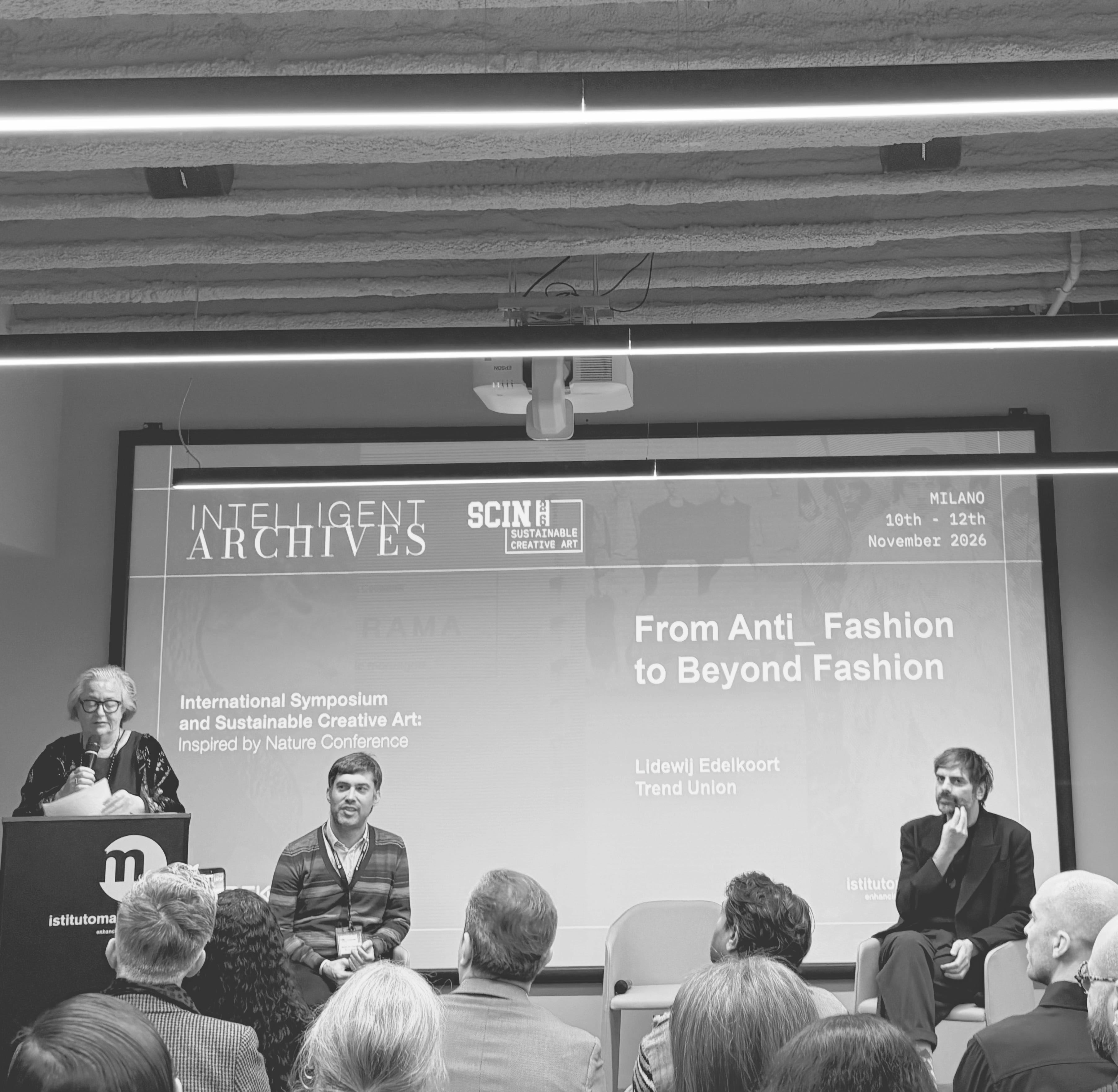
On the second day, I had the opportunity to listen to Li Edelkoort present Beyond Fashion, her latest manifesto. Ten years after publishing her Anti-Fashion Manifesto, Edelkoort is asking a different question. Not simply what is wrong with fashion, but what comes next.
What really stayed with me was how little her conversation was about fashion in its conventional sense. Of course she spoke about streetwear (or rather, its demise), tailoring, and textiles, but these were starting points to a bigger picture about belonging, identity, creativity and humanity!
With her Anti-Fashion Manifesto in 2015, Edelkoort’s criticism of the industry was direct. Head-on. Fashion had become increasingly driven by marketing, accelerated production cycles and commercial expectations, often at the expense of creativity and craftsmanship. Fast forward a decade later, and unfortunately many of those concerns remain unresolved.
With Beyond Fashion, Edelkoort doesn’t appear to just critique the system, but rather proposes a series of transformations about how fashion is becoming conventional, traditional, ancestral, spiritual, collective, robotic and, ultimately, returning to arts and crafts.
We still produce more clothing than we need. Creative directors are expected to deliver constant novelty. Brands compete for attention in an increasingly saturated market, while the relationship between design, making and consumption becomes more and more fragmented.
I’ve written about some of these contradictions myself, particularly the growing tendency to confuse influence with creative authority, or performance with genuine contribution. So there was something rather reassuring about hearing Edelkoort share similar concerns.
R.I.P Streetwear! Fashion Becomes Conventional.
Three years after the death of Virgil Abloh, the man that elevated streetwear into luxury status, suddenly, and surprisingly, everything changed. “I’ve never seen such dramatic change on such a small moment, like only a few months”, Edelkoort emphasises. Starting in Asia and then making its way across the world, streetwear is being replaced by tailoring, with cleaner and leaner silhouettes emerging. Shirts (button-downs to be exact), replacing t-shirts, and the moccasin reigning over the sneaker.
Edelkoort stresses that streetwear as we know it is gone, and will need to reinvent itself, all while making a jibe at Balenciaga, commenting that they ‘cannot reignite something that is gone’. Ouch!
She continues by saying that brands are failing to acknowledge this shift, and emphasises that “CEOs of the different luxury companies, they have a lot of knowledge, except they don’t know about forecasts”.
I’m not that bothered by this return to tailoring, I actually welcome it. The industry has always moved between formality and informality. But, it’s Edelkoort’s suggestion that the cause of this shift reflects something that is happening beyond clothing.
According to Edelkoort, the digital age has “changed us, exacerbated our lack of purpose, with traditions and rituals disappearing, turning us into introverted citizens”.
Fashion Becomes Traditional
The classic wardrobe and dressing conventionally becomes a sense of belonging. A familiar wardrobe becomes a way to create order when the world currently feels unpredictable. We want clothes that show that we are together. There is a longing to bring back an analogue togetherness. Analogue, Edelkoort stresses, will be the key word for at least the next 10 years.
We dress to distinguish ourselves, certainly. But we also dress to recognise one another. But if fashion becomes more conventional and traditional, where does experimentation go?
Edelkoort anticipates a reaction, with a new avant-garde eventually disrupting these conservative codes through imperfections, exaggeration and unexpected combinations.
Perhaps fashion needs periods of conformity to create the conditions for rebellion.
Fashion Becomes Ancestral and Outsider
The highlight for me was Edelkoort’s discussion of the global South, the ancestral clothing and the expanding influence of creative practices outside of the conventional Western fashion system. I am currently writing a book about designing from identity, with a focus on non-Western regions, in partnership with Bloomsbury Visual Arts. Listening to her made me feel we are contributing to the same conversation.
The demand for tradition is reflected in the revival of regional and local clothing, which adds longevity to the clothes that originated there and where ancestral ideas are rediscovered in contemporary fashion. They bring other structures to shape, other ways of dressing, and moving, since they are made to empower people. The adaptation of these patterns represents various perspectives on the link between fabric, body, movement and identity.
For Edelkoort, it’s about celebrating the rise of “outsider art, regional crafts, and tribal trends that are creating waves when they take center stage.” She then adds that, “their time of their inspiration has come, they have been dependent on the Western gates for such a long time, and finally, they can have their own opinion about themselves”.
Edelkoort highlights how the campaigns produced by designers and photographers from these regions are bolder and emotionally richer. They are intuitive forces that just know how to transform fashion. “When we look at what’s happening outside the traditional western fashion capitals, it’s more youthful and innovative”. On the other hand, for us in the Western regions, and let’s be honest, marketing has sucked substance out of the system. The future of fashion may become more diverse not simply because new voices are included, but because the structures determining whose voices matter begin to change.
For many years, fashion education has mostly depended on a rather uniform set of institutional traditions, references and approaches. The frameworks used to teach and assess design often have their roots in Western fashion history, despite the celebration of cultural variety.
But what happens when we reverse that relationship?
Edelkoort also went on to describe her involvement in developing a design curriculum in Qatar, where the intention was to begin with local clothing traditions rather than automatically adopting Western approaches to pattern cutting and garment construction.
What if local knowledge is not treated as an additional source of inspiration, but as the foundation of the design process itself?
Fashion Becoming Animate and Focused
Fashion is overproducing, and too many products are created primarily to satisfy marketing demands. They struggle to communicate anything meaningful, and according to Edelkoort, “this makes the younger generation angry and ashamed, leading them to be put off by brands.”
Just by looking at the recent runway shows, Edelkoort observed that there was so much similarity between collections, at times making it difficult to distinguish one brand from the other.
With the need for more focus and awareness, Edelkoort suggests that fashion will possibly need less variation. Even she was surprised to reach that conclusion, adding that “maybe less variation is good for everybody”. This connects to the previous point of fashion becoming conventional. Fashion might want to recapture a sense of belonging.
In Once Upon a DNA, I questioned what it means when luxury fashion houses lose their creative languages or codes that made them so distinct. So, Edelkoort’s suggestion of less variation with greater uniformity might benefit brands by reducing unnecessary product development. But do fewer designs necessarily mean producing fewer garments? And more importantly, does a more focused collection come at the expense of creative individuality?
The future of making in an artificial world
As the talk shifted to robotics, artificial intelligence, and the prospect of a world in which traditional work and education are drastically changed, if not completely eliminated, Edelkoort’s projections grew more radical.
She imagined robots participating in domestic life, manufacturing garments and potentially allowing people to make clothing at home again. In a certain way, we’re not that far off. We are already increasingly dependent on digitalisation in our daily lives.
But the underlying questions are important.
If technology can increasingly generate designs, automate production and reproduce visual languages, what will distinguish human creativity? And what should fashion education prioritise in response?
Some of the scenarios she presented may feel distant, and to be honest, I am less convinced by the suggestion that artificial intelligence will make conventional learning unnecessary. I believe that the need to develop judgement, critical thinking and research skills will not disappear, but these abilities will need to evolve for a generation growing up with AI. This thought connects directly to the research paper I presented at the conference, in which I argued that fashion education, and education in general, need to develop different forms of literacy to respond to AI.
Students need to understand what generative AI can do, but also its limitations, and importantly, the difference between something that hasn’t been digitised and something that doesn’t exist. Students might confuse a lack of easily accessible information with a lack of historical importance. If certain designers or cultural practices are poorly represented in accessible digital sources, we need to consider how that might affect their visibility within AI-generated histories.
I would argue that the answer cannot simply be greater technical proficiency. Education needs to be revisited for a generation born into AI. The ability to operate new tools will undoubtedly matter. But so will the capacity to question, interpret, research, collaborate and understand the cultural implications of what we create. If we teach them to question AI-generated accounts, to investigate archives and to seek out different sources of knowledge, we give them something much more valuable.
We give them the ability not simply to inherit an established fashion canon, but to question it, expand it and contribute to it.
Beyond Fashion, towards meaning
Edelkoort concluded by revisiting an idea I was particularly pleased to hear.
The age of the amateur.
I remembered Edelkoort discussing this during the pandemic, in a 2020 conversation with Imran Amed for The Business of Fashion. She imagined a future in which people would rediscover the pleasure of making, start smaller creative initiatives, share resources and work collectively. During the conversation, I really appreciated her explanation of the word amateur.
In English, we tend to associate it with someone inexperienced, unskilled or simply not professional.
But in French, amateur also means someone who loves something.
Amateurs d’art.
People who create, collect or engage with something because they genuinely love it.
A rather different proposition.
Hearing Edelkoort return to the amateur in Beyond Fashion felt almost like picking up a conversation where we’d left it.
Only this time, the context had changed. Six years ago, Edelkoort imagined the amateur as someone who might help rebuild a world interrupted by a pandemic. Today, she imagines the amateur finding purpose in a society increasingly shaped by artificial intelligence and automation.
I do not necessarily agree with every prediction in Beyond Fashion. Nor do I think that fashion’s future can be understood through a single narrative. But perhaps the value of a manifesto lies less in its ability to predict what will happen and more in its capacity to challenge how we think.
What I took away from listening to her was the idea that fashion needs to reconsider its purpose. Not simply how it produces, communicates or sells, but what it contributes to our lives.
Can it preserve cultural knowledge while allowing new forms of expression to emerge?
And can we imagine a fashion system in which creativity is valued not only for its commercial potential, but for its ability to contribute something meaningful to society?
Maybe the future of fashion isn’t entirely about what comes next. Perhaps it’s also about remembering what brought us here in the first place.
After all, before we became professionals, weren’t we all amateurs?
These reflections are based on Li Edelkoort’s presentation of Beyond Fashion at SCIN 2026, on 11 November 2026. They represent my personal interpretation of the ideas discussed, rather than a complete account of the manifesto.